
That feeling of dread when the “Check Engine” light suddenly flickers on your dashboard? We’ve all experienced it. Your mind races, imagining a huge repair bill and days without your car. It’s an unsettling moment because, unlike a flat tire or a broken headlight, you can’t just look under the hood to see what’s wrong. The check engine light is your car’s way of communicating, but unless you’re a mechanic, it’s hard to understand.
In today’s cars, that mysterious light usually means it’s time for a diagnostic test. This isn’t a simple scan that tells you “your engine is broken.” It’s a detailed process that connects to your car’s computer system to figure out exactly what’s wrong. It’s like a doctor’s visit for your car, where we use technology to find the root cause of a problem before it gets worse.
The “Why” Behind the Light – Diagnostic Test Finds the Problem
Think of your car’s computer system as its nervous system. It’s linked to dozens of sensors that monitor everything from engine temperature to fuel mixture and transmission performance. When a sensor detects a problem, it sends a signal to the car’s computer, which stores this information as a trouble code.
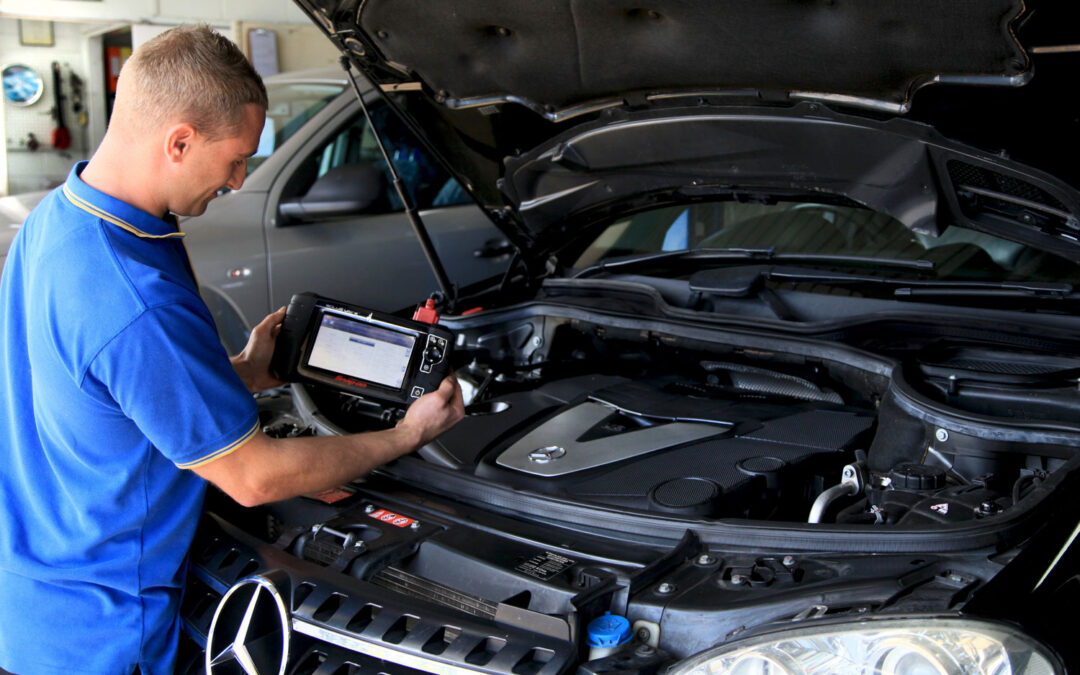
An auto computer diagnostic test in McKinney TX, involves using a scanner to read these codes. Here’s a quick overview of the process:
- The Connection – A technician connects a specialized scanner to your car’s OBD-II (On-Board Diagnostics) port, a standard port found under the dashboard of all cars made since 1996.
- The Scan – The scanner talks to the car’s computer and retrieves the stored trouble codes. These codes are alphanumeric, like P0420 or P0300, which represent specific parts of the car. The first character shows where the issue is, such as ‘P’ for Powertrain, ‘C’ for Chassis, or ‘B’ for Body.
- The Diagnosis – This is where a technician’s skill comes into play. The code is a clue, not the full answer. For instance, a code might say “Engine Misfire Detected in Cylinder 3.” This doesn’t mean the spark plug is automatically the problem. It could also be a faulty ignition coil or a clogged fuel injector. The technician uses their knowledge and the code as a starting point, then conducts a physical inspection to accurately diagnose the issue.
- The Solution – Once the problem is found, the technician can recommend the right repair. This might be something simple like tightening a gas cap or something more complex like replacing a sensor or catalytic converter.
Common Issues a Diagnostic Test Can Uncover
The check engine light is a general warning, but a diagnostic test can reveal specific problems. It can identify many issues that could lead to costly repairs if not addressed. Some common problems that trigger a check engine light and can be found through a diagnostic test include:
- Faulty Oxygen Sensor – This sensor measures the amount of unburned oxygen in your exhaust. If it fails, your car’s computer can’t determine the correct air-fuel mixture, leading to lower fuel efficiency and higher emissions.
- Bad Catalytic Converter – The catalytic converter changes harmful exhaust gases into less harmful ones. This is a crucial part of your car’s emission system, and failure can harm the environment and affect performance. CarMD’s 2025 Vehicle Health Index report notes that replacing a catalytic converter is often the most expensive repair, so catching issues early is vital.
- Worn-Out Spark Plugs or Ignition Coils – Spark plugs ignite the fuel-air mixture in your engine’s cylinders. If they wear out or get dirty, they can cause misfires, poor acceleration, and lower fuel economy.
- A Loose Gas Cap: This might seem minor, but a loose or faulty gas cap can trigger the check engine light because it can create a leak in the evaporative emission control (EVAP) system. This is an easy, inexpensive fix that a auto computer diagnostic test in McKinney, TX, can spot.
While a typical diagnostic test might cost between $50 and $100, it can save you hundreds or even thousands in the long run by keeping small issues from becoming major problems.
Your Diagnostic FAQs, Answered
Q: Can I drive my car with the check engine light on?
A: It depends. If the light is steady and your car drives normally, it’s usually a less urgent issue, like a loose gas cap. If the light is flashing, however, it indicates a serious problem, such as a severe engine misfire, and you should pull over and have the car towed to a mechanic as soon as possible.
Q: Does a diagnostic test fix the problem?
A: No, the diagnostic test only identifies the issue. It gives the technician the details they need to perform the repair efficiently. A good diagnostic test ensures you won’t pay for unnecessary part replacements.
Q: Can auto parts stores do a diagnostic test for free?
A: Many auto parts stores offer basic scans for free. However, these scans typically only read generic trouble codes. They don’t provide the in-depth analysis and expert insight that a professional mechanic can offer. A professional auto computer diagnostic test in McKinney, TX, uses the code as a starting point for a full inspection to find the actual issue.
Elite Performance Automotive is The Final Step to Your Car’s Health
When your car’s dashboard lights are sending a message, you need a mechanic who understands its language. At Elite Performance Automotive in McKinney, TX, we specialize in both fixing and diagnosing cars. Our technicians use advanced diagnostic tools to find the root cause of any issue, big or small.
We believe that a correct diagnosis is the first step toward an effective repair. This saves you time, money, and the stress of guesswork. We are committed to getting you back on the road safely and efficiently, ensuring your vehicle is in good hands.
If that check engine light is of concern to you, don’t wait for a small issue to turn into a big headache. Visit Elite Performance Automotive at 330 Industrial Blvd, Ste 109, McKinney, TX 75069 or call us at (214) 491-0348 to schedule a auto computer diagnostic test in McKinney, TX. Let us help you solve your car problems.